
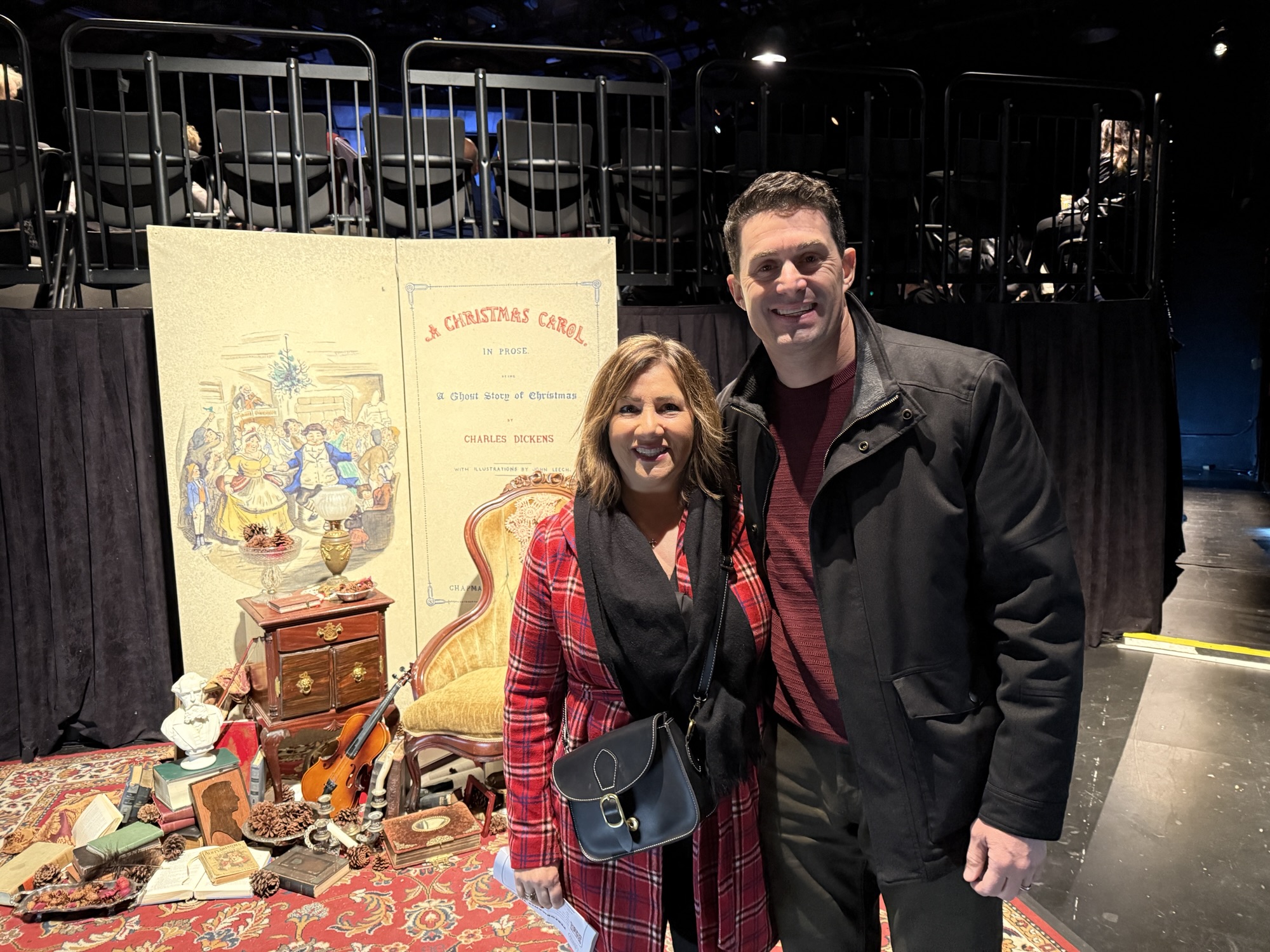
A QUICK REVIEW OF EBENEZER, in theatres now.

My two favorite holiday classics of all time are A Christmas Carol and It’s a Wonderful Life. Last night, my husband and I went to see the new film Ebenezer starring Johnny Depp in the title role in the theatre. I was so hoping to love this adaptation of Dickens’s masterpiece. Unfortunately, as someone who adores this story and is a self-proclaimed aficionado of it (having written what I imagine the sequel of Scrooge’s life to have been From Humbug to Humble), I came away feeling disappointed for various reasons. If you’ll allow me, I’d like to tell you why, and then I’d like to share why I believe both A Christmas Carol and It’s a Wonderful Life remain two of the best Christmas stories you’ll see on the screen and what they have in common.
First, let’s tackle what most disappointed me about the film Ebenezer. The most egregious disassociation from Dickens’s work was the second ghost, The Ghost of Christmas Present, and it had nothing to do with the actor who played the ghost and more to do with the way the film depicted that ghost. He certainly looked the part in his costume, but in Dickens’s novel, The Ghost of Christmas Present is jovial and merry. He appears in Scrooge’s living room with a feast and candles. He is filled with joy and is larger than life. He represents the spirit of giving, celebration, fellowship, and cheerfulness. The Ghost of Christmas Present’s job is to show Scrooge how he is NOW, what he is doing to others, especially to Bob Cratchit and his family. True, he does leave Scrooge with images of the two children depicting “ignorance and want”; that’s the most somber part of his interaction with this ghost. But during these scenes in the novel, Scrooge gets to see himself being made fun of, teased, and he even hears the harsh words Mrs. Cratchit has to say about him. The way this ghost was presented in Ebenezer is far from that. He is a dark character, about to fade away from the present (dying in a sense, if you will), and has no jovial spirit about him at all. I kept waiting for him to change and be warm and welcoming, the way Dickens wrote him. That did not come to pass.
Second, the first ghost, The Ghost of Christmas Present, was unusually creepy and very difficult to understand, as they put a strange echo to her voice. I realize Dickens wrote a ghost story, but this ghost was a little over the top, coming across as mean and a bit evil at times. As the purpose of the ghosts is to help nudge Scrooge toward a path of redemption, I felt this depiction missed the mark.
Third, Scrooge’s story is exactly that—one of redemption. It’s the whole point of the novella. So, if that is the crux of the book, Scrooge’s transformation in this adaptation was lackluster. Yes, he changed, and the only exchange I thought was done well was the exchange between Scrooge and his nephew, Fred. And even this exchange lacked a little something. The scene where Ebenezer Scrooge throws open the window after he wakes up in the morning as a transformed man was off; yes, he was giddy, but he throws a pot of maggot-filled food through the window (almost hitting the boy) and shouts down to the boy through broken glass: “What day is it?” The boy says, “Why it’s Christmas Day.” (This is in the original novella). But that’s it. No telling him to go around to the Poulterer’s shop and buy the goose so Scrooge can send it to Bob Cratchit’s house. Nope. It’s one of the greatest moments in the book! Scrooge wakes up changed, giddy, filled with life and starts immediately becoming a better man. Sending that goose to the Cratchit’s house is just the beginning. This full scene was completely absent from this film.

Now to the film’s positive points, Johnny Depp was an okay Scrooge. However, his voice is so deep and he often mumbles, so it’s difficult to hear the dialogue, even when you’re in a theatre and the sound is blasting. But Depp puts his own spin on things which is always entertaining (especially when Jack Sparrow seemed to come out now and then). I’m a fan of his, but my two favorite portrayals of Ebenezer Scrooge on screen are by George C. Scott and Albert Finney (yes, I know Finney goes over the top after his transformation, but if you want a “feel good” Scrooge transformation, his is the one). George C. Scott’s performance is the one I believe is the one closest to the novel. I also got a charge out of the way each stave was depicted on screen with big, old fashioned red lettering. I did love that. And the sets, costumes, and effects were pretty cool, too. Totally worth it just for that.
I like to be a part of all things A Christmas Carol, including seeing every adaptation I can find. Like I said previously, I wanted to like Ebenezer a lot more than I did, but you may find that you love it. Lots of people have enjoyed this adaptation; it’s made lots of money at the box office, and I am glad to see it having success in the theatres, and anytime this great work is celebrated, I think it’s wonderful.
__________
A CHANGE OF HEART: WHAT EBENEZER SCROOGE AND GEORGE BAILEY TEACH US

Let’s move on, shall we? I’d like to share the similarities between A Christmas Carol and It’s a Wonderful Life, because it hit me this morning just how powerful these stories are and why they continue to resonate with people 183 years later (A Christmas Carol) and 80 years later almost to the day for It’s a Wonderful Life.
Both stories are about redemption, hope, grace, purpose, the value of appreciating those around you, and the immeasurable value of an ordinary life. Let’s dig deeper.
SUPERNATURAL INTERVENTION: Both Scrooge and George are the recipients of supernatural intervention. Three spirits visit Scrooge (along with Jacob Marley) and an angel named Clarence intervenes in George’s life.
A LOOK AT THEIR LIVES: Scrooge has the incredible opportunity to revisit his past, present and future. George sees what the world would have been like had he not been born.
THE CONSEQUENCES OF CHOICES: Scrooge is given the chance to change his heart, to start over. George is able to “see” the value of his life and those he loves.
PERSPECTIVE: Scrooge realizes his pursuit of money, money, money has cost him human connection and love (this is so sad to me). George realizes his pursuit of what he thinks he missed has blinded him to what he actually has: a wonderful life (George lacks contentment; so does Scrooge).
COMMUNITY: Scrooge, in the end, reconnects with his family. George returns home from his night a renewed man and filled with appreciation for his life.
DREAMS: Both men do not believe they have lived out their dreams…Scrooge is bitter and isolated, and George feels trapped by his responsibilities.
DEFINITION OF SUCCESS: Both stories challenge the definition of success. Scrooge measures his through money and possessions. George measures success by travel, adventure, personal ambition, and what he wants to accomplish.
PEOPLE’S LIVES CAN CHANGE THE LIVES OF COUNTLESS OTHERS: Scrooge discovers that he has the wealth and disposition to help others and offer goodness to the world. George discovers the ways in which he already has changed lives…he just never thought about the ways he impacted people.
TRANSFORMATION: Scrooge’s transformation happens after the final visit from the third ghost when he wakes up Christmas morning. George’s transformation happens when he comes back home and sees what it happening in his living room (how can we forget him kissing the broken part of his banister? That one moment brings me to tears every time.)
As I crawled into bed last night thinking of the film Ebenezer, my favorite versions of A Christmas Carol, and It’s a Wonderful Life, I couldn’t help but be inspired to write about this. These are my two favorite Christmas classics. I can read/watch them over and over and never get bored. The themes of both stories tug on your heartstrings and make you examine your own life.
You see, that’s just it: We examine our own lives through these stories.
And that’s why they’ll always remain relevant and why we can see pieces of ourselves in both Ebenezer Scrooge and George Bailey.
About the author:

STEPHANIE VERNI is the author of FROM HUMBUG TO HUMBLE, THE TRANSFORMATION OF EBENEZER SCROOGE, the continuation of Ebenezer Scrooge’s story after his transformation. She is also the author of the soon-to-be-released THE SWEETNESS WE SHARE and RESTORED: PIECE BY PIECE. She has also authored THE ONES CLOSEST TO YOU, THE LETTERS IN THE BOOKS; BENEATH THE MIMOSA TREE; INN SIGNIFICANT; LITTLE MILESTONES; THE POSTCARD; and ANNA IN TUSCANY. She is also a co-author of the textbook, EVENT PLANNING & MANAGEMENT: COMMUNICATING THEORY & PRACTICE. Currently an adjunct professor at Stevenson University Online, she instructs communication courses for undergraduate and graduate students. She and her husband reside in Severna Park, Maryland, have two children, and a little boat that makes them immensely happy.
Connect with Stephanie on Instagram at stephanieverniwrites, (provided they allow it) and on TikTok at stephanieverniwrites.



Leave a Reply